

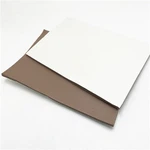
Hey there! As a supplier of Flexibond PVC Sheet, I often get asked about static electricity generation in these sheets. So, I thought I'd take a deep - dive into this topic and share some insights with you.
First off, let's understand what static electricity is. Static electricity is basically an imbalance of electric charges within or on the surface of a material. It occurs when two materials come into contact and then separate, causing electrons to transfer from one material to the other. This leaves one material with a positive charge and the other with a negative charge.
Now, when it comes to Flexibond PVC Sheet, static electricity generation can happen due to several reasons. One of the main factors is friction. When the PVC sheet rubs against another surface, like a conveyor belt during the manufacturing process or a packaging material, electrons can be transferred. For example, if the Flexibond PVC Sheet is being unrolled from a large roll, the friction between the layers of the sheet can generate static electricity.
Another reason could be the environmental conditions. Dry air is a major culprit in static electricity build - up. In a low - humidity environment, there are fewer water molecules in the air to conduct the charges away. So, when the Flexibond PVC Sheet is in a dry warehouse or a climate - controlled room with low humidity, static electricity can easily accumulate on its surface.


The chemical composition of the PVC itself also plays a role. PVC is a polymer, and its molecular structure can influence how easily it gains or loses electrons. Some additives in the Flexibond PVC Sheet might affect its electrical properties as well. For instance, if there are certain fillers or plasticizers in the sheet, they could either enhance or reduce the tendency to generate static electricity.
The generation of static electricity in Flexibond PVC Sheet can have both positive and negative impacts. On the positive side, in some industrial applications, static electricity can be used to attract dust or small particles to the sheet. This can be useful in processes where the sheet needs to pick up debris for cleaning or separation purposes.
However, the negative impacts are more common. Static electricity can cause dust and dirt to stick to the surface of the Flexibond PVC Sheet. This not only affects the appearance of the sheet but can also be a problem in applications where a clean surface is crucial, like in the electronics or food packaging industries. Moreover, static discharge can be a safety hazard. In an environment where there are flammable gases or dust, a static spark from the PVC sheet could potentially ignite them, leading to a fire or explosion.
To deal with static electricity generation in Flexibond PVC Sheet, there are several methods. One of the simplest ways is to increase the humidity in the environment. By using humidifiers, we can add more water molecules to the air, which helps to conduct the charges away from the sheet. Another approach is to use anti - static agents. These can be applied to the surface of the sheet during the manufacturing process or as a coating later on. Anti - static agents work by creating a thin layer on the sheet that allows the charges to dissipate.
Now, let me tell you a bit about some related products. If you're interested in other types of PVC foam, we have Good Recovery PVC Foam. This foam has excellent recovery properties, which makes it suitable for applications where it needs to be compressed and then return to its original shape.
We also offer Low Density Quick Recovery PVC Foam. As the name suggests, it has a low density and can quickly recover after being deformed. This is great for applications where weight is a concern.
And for those looking for a specific color option, our Blue PVC Sponge Foam is a great choice. It has the same high - quality properties as our other PVC foams but comes in a nice blue color.
If you're in the market for Flexibond PVC Sheet or any of our other PVC foam products, I'd love to have a chat with you. Whether you have questions about static electricity, product specifications, or pricing, I'm here to help. We can work together to find the best solution for your specific needs. So, don't hesitate to reach out and start a conversation about your procurement requirements.
References
- "Polymer Science and Technology" by Donald R. Paul and Christopher B. Bucknall
- "Electrostatics in Industry: Principles and Applications" by Eric A. Morey
- Technical reports on PVC materials from industry research institutions